



 WhatsApp

DOING HOLDINGS
Henan Doing Environmental Protection Technology Co., Ltd
E waste recycling machine manufacturer
- WhatsApp: +86 150 3713 8562
- Email: market@doinggroup.com

Industry News

Solar Panel Dismantling and Recycling Machine Price
 October 14, 2026
- Industry News
- Leave a message
- Chat online
The price of a complete solar panel dismantling and recycling machine depends mainly on processing capacity, automation level, panel type, and the materials you want to recover. As a preliminary budget, a relatively simple semi-automatic line may cost around $40,000–$80,000, while a more automated system may fall around $80,000–$150,000. Larger or highly customized projects can reach $150,000–$300,000 or more.
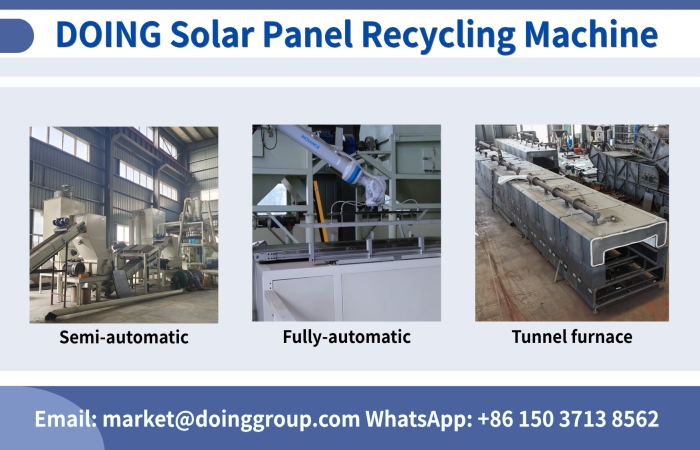 Three solar panel recycling solutions
These figures are only general reference ranges, not fixed quotations. The actual cost depends on the configuration required for your panels and production volume. For this reason, it is more useful to understand what drives the investment before comparing supplier offers.
What Determines the Price of a Solar Panel Recycling Machine?
Several factors have the biggest impact on the investment:
Processing capacity
Capacity is one of the first things to define. A line processing several hundred kilograms per hour requires less equipment and automation than a system designed for around 1,000 kg/h or higher.
For example, DOING ECO's fully automatic solar panel recycling line can process about 55–60 panels per hour, or around 1,000 kg/h, depending on panel specifications and operating conditions.
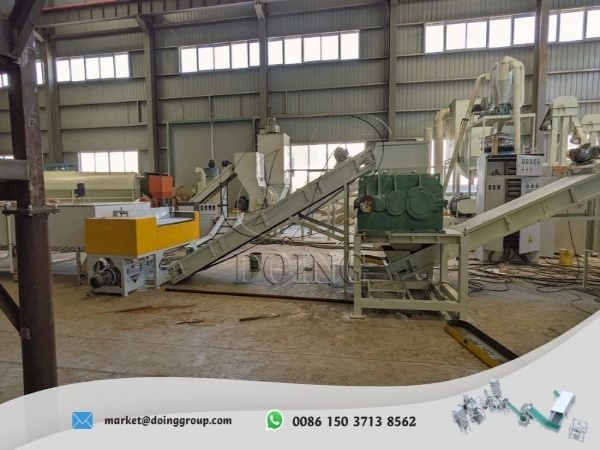
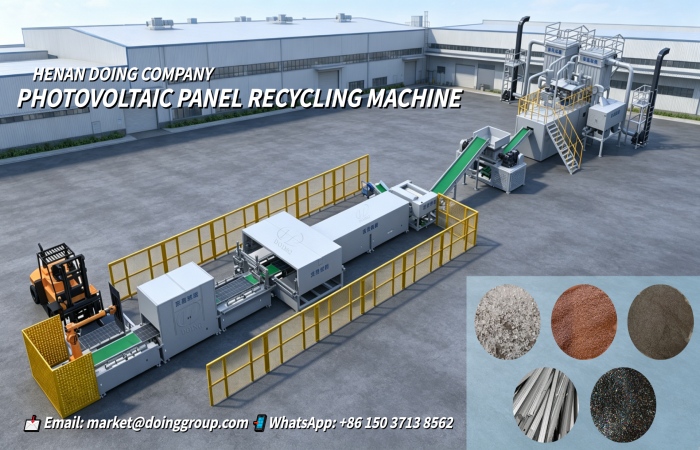 Fully automatic recycling line
When comparing quotations, it is useful to convert hourly capacity into daily or annual processing volume. A line rated at 1,000 kg/h could theoretically process about 24 tons per day under 24-hour operation, although actual output depends on working hours, feeding efficiency, maintenance, and panel weight.
Automation level
Automation also affects the equipment investment. A semi-automatic system requires more manual work for dismantling and material handling but generally has a simpler configuration. This can suit recycling businesses with a moderate feedstock supply or those looking to limit their initial investment. A fully automatic line integrates more processing and conveying stages and reduces manual handling. It is more suitable for larger operations where stable throughput and labor efficiency are important.
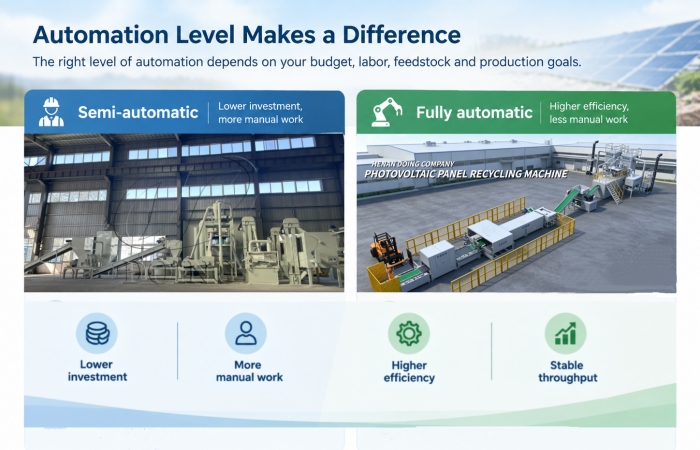 Semi-automatic vs. fully automatic
The right choice therefore depends not only on the purchase budget, but also on available labor, expected feedstock, and the required production volume.
Panel type and recovery requirements
The type of solar panel also matters. DOING ECO's mechanical recycling process is mainly designed for single-glass solar panels. The basic process includes frame and junction box removal, glass removal, crushing, screening, and physical separation. Depending on the configuration, the line can recover aluminum, glass, copper and other metals, silicon-containing materials, and plastics.
If the project involves double-glass panels or requires a different recovery method, the equipment configuration needs to be evaluated separately. DOING ECO also provides a tunnel-furnace pyrolysis solution for single- and double-glass panels, particularly for larger projects with annual processing requirements above 10,000 tons.
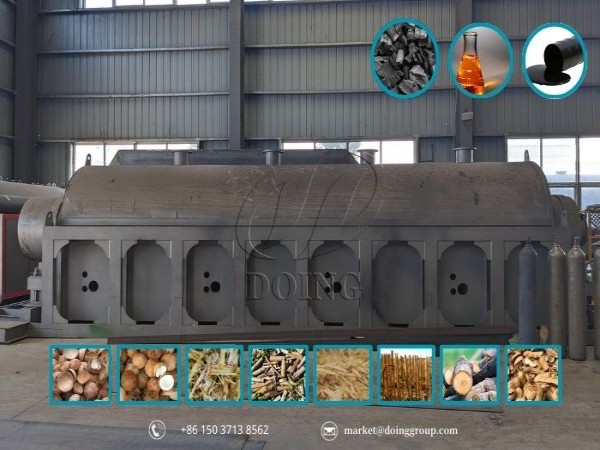
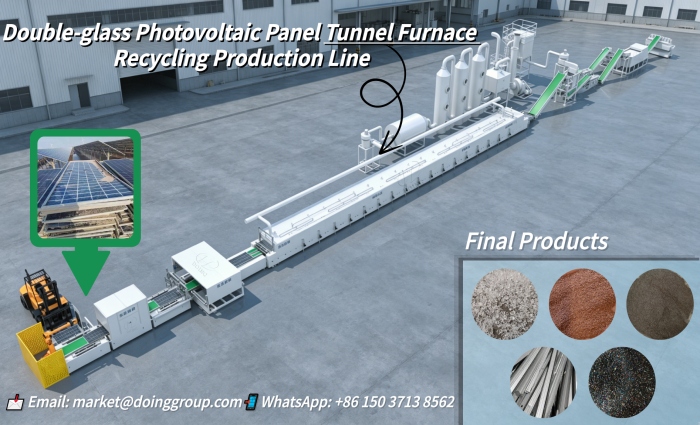 Solar panel tunnel furnace
What Does a Complete Solar Panel Recycling Line Include?
A complete line is more than a single crusher. The solar panel recycling equipment normally follows the material flow from dismantling to separation.
For a mechanical recycling system, the process can include:
Panel dismantling → aluminum frame and J-box removal → glass removal → crushing → screening → gravity/electrostatic separation → material collection
This configuration allows different valuable fractions to be separated instead of simply reducing the panels to mixed waste.
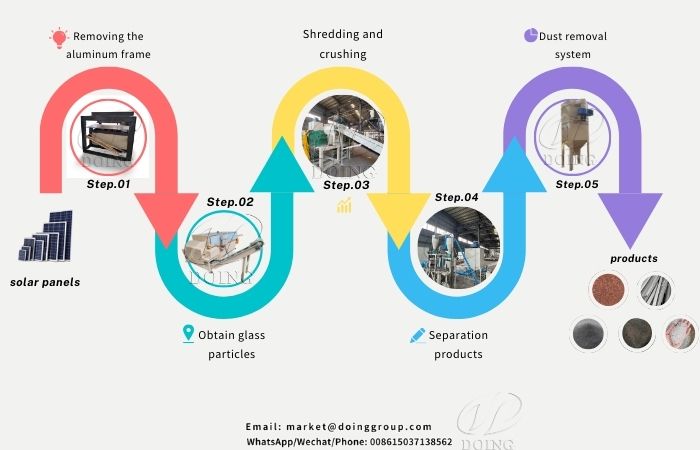 Mechanical recycling process
DOING ECO's mechanical solar panel recycling equipment uses a dry physical separation process, so it does not require chemical treatment. The system can be equipped with PLC automation and pulse dust removal, helping operators control the production process while managing dust generated during crushing and separation.
The final recovery rate can reach 98% or more, with material purity of up to 99%, depending on the feedstock and process configuration.
For customers processing a relatively small volume, a simpler semi-automatic line may be sufficient. For higher-volume projects, a fully automatic configuration can reduce manual work and provide more consistent processing.
How to Choose the Right Configuration Before Requesting a Quote
The initial equipment budget becomes much easier to determine once the project requirements are clear. Before requesting a quotation, prepare four basic pieces of information:
Type of waste solar panels — single-glass, double-glass, or mixed.
Available feedstock — such as tons per day or tons per year.
Target capacity — for example, 500 kg/h or 1,000 kg/h.
Materials to recover — glass, aluminum, copper, silicon-containing materials, plastics, or other fractions.
Photos or samples of the waste panels can also help determine the appropriate process.
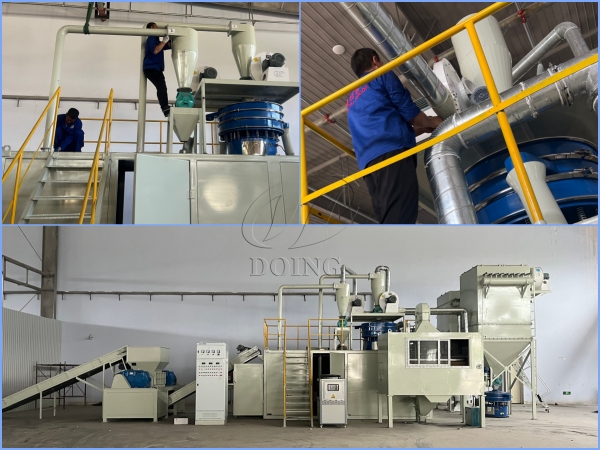
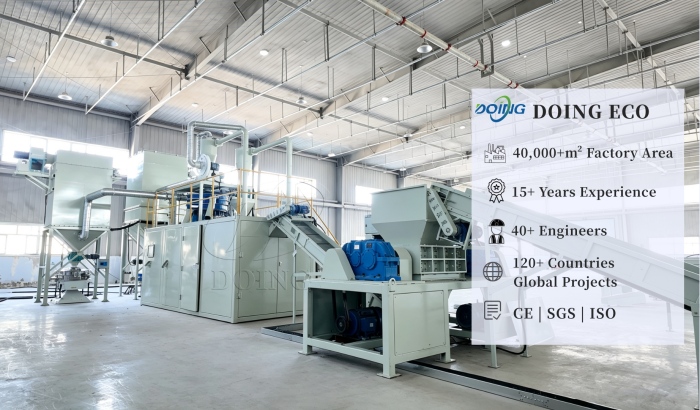 DOING ECO photovoltaic panel recycling machine
With these details, the supplier can determine whether a semi-automatic, fully automatic, or thermal-treatment solution is appropriate and provide a project-specific quotation.
For customers looking for a solar panel dismantling machine or complete solar panel recycling equipment for commercial or industrial use, DOING ECO can provide equipment selection, process design, manufacturing, installation, commissioning, and operator training. The final configuration is based on the actual panel type, processing volume, factory conditions, and recovery requirements rather than a generic machine specification.
FAQ
1. What is the typical price of a complete solar panel recycling line?
As a general preliminary budget, simpler semi-automatic systems may start at around $40,000, while larger automated and customized projects can reach $300,000 or more. The actual quotation depends on the specific configuration.
2. What capacity can a solar panel recycling machine process?
DOING ECO offers configurations for different production requirements. Its fully automatic line can reach about 1,000 kg/h under suitable operating conditions, while larger projects can be customized.
3. Can the machine recycle double-glass solar panels?
DOING ECO's mechanical recycling line is mainly designed for single-glass panels. For single- and double-glass panels, a tunnel-furnace pyrolysis solution can be considered for larger-scale projects.
4. What materials can be recovered?
Depending on the process configuration, the line can recover aluminum, glass, copper and other metals, silicon-containing materials, and plastics.
5. What information is needed for an accurate quotation?
The supplier normally needs the panel type, available feedstock, required capacity, and target recovered materials. Photos or samples of the waste panels can also help with equipment selection.
Contact Us
If you want to get more details, you can send E-mail to market@doinggroup.com. Or you can consult our professional engineers and specialized sales team by leaving a message in below form. We will contact you ASAP.