



 WhatsApp

DOING HOLDINGS
Henan Doing Environmental Protection Technology Co., Ltd
E waste recycling machine manufacturer
- WhatsApp: +86 150 3713 8562
- Email: market@doinggroup.com

Industry News

Lithium Battery Recycling Plant Compliance: Key Risks to Consider
 September 20, 2026
- Industry News
- Leave a message
- Chat online
Setting up a lithium battery recycling plant involves more than choosing the right recycling machine. Investors also need to consider waste classification, battery storage, fire safety, worker protection, environmental controls, transportation, and local permits.
These issues are especially important because lithium-ion batteries can still pose fire and chemical hazards after use. In the U.S., for example, the EPA notes that many discarded lithium-ion batteries may exhibit hazardous characteristics, while specific requirements can vary by state and facility type.
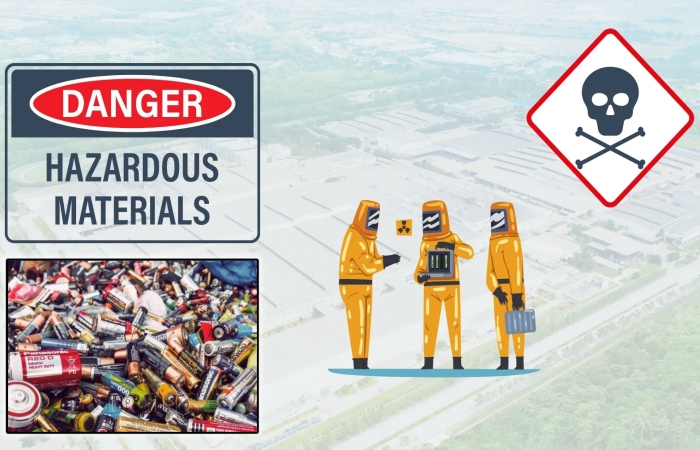 Used lithium batteries and safety hazards
For this reason, lithium battery recycling plant compliance should be considered during plant planning and equipment selection, rather than after the recycling line has already been installed.
1. What Are the Biggest Compliance Risks?
The exact requirements depend on the country and local regulations, but most lithium battery recycling plants need to address several common lithium battery recycling plant risks.
| Compliance area | Main risk | What to consider |
| Waste classification | Batteries or recovered materials may be regulated as hazardous waste | Confirm applicable waste classifications and local requirements |
| Battery storage | Damaged or charged batteries can cause fire or thermal runaway | Use suitable storage areas, containers and inspection procedures |
| Fire and worker safety | Crushing and handling batteries can create fire, electrical and chemical hazards | Prepare safety procedures, training, PPE and emergency response |
| Dust and emissions | Crushing and separation can generate fine particles | Use suitable enclosure, ventilation and dust-collection systems |
| Transportation | Used or damaged batteries may be subject to dangerous-goods rules | Confirm packaging, labeling and transportation requirements |
| Recovered materials | Black mass and other outputs may have additional requirements | Test and classify outputs before downstream handling |
These lithium battery recycling plant risks are connected. For example, the way batteries are stored can affect fire safety, while the recycling process can affect waste classification and environmental requirements.
Therefore, a plant should be designed around the feedstock, process, storage, outputs and local regulations as a complete system.
2. Why Are Battery Storage and Fire Safety So Important?
A lithium battery recycling project can face safety risks before the batteries even enter the recycling machine. End-of-life batteries may have different chemistries and physical conditions. Damaged, swollen, leaking or defective batteries require particular attention because they can create fire or thermal-runaway risks.
A commercial plant should therefore have clearly defined areas for:
Incoming battery inspection and sorting
Normal batteries waiting for processing
Damaged or defective batteries
Recovered materials
Waste residues
Emergency isolation
Employees should also know how to identify abnormal conditions such as overheating, swelling, smoke or leakage.
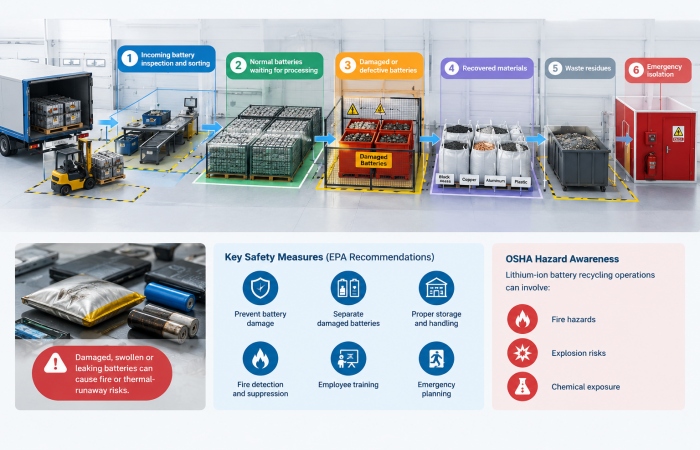 Battery storage and safety areas
The EPA recommends measures including preventing battery damage, separating damaged batteries, appropriate storage, fire detection and suppression, employee training and emergency planning. OSHA also identifies fire, explosion and chemical hazards associated with lithium-ion battery recycling operations.
This means a recycling machine alone cannot make a plant safe or compliant. Storage, fire protection, emergency procedures and worker training need to be included in the overall project design.
3. How Does the Recycling Process Affect Compliance?
The recycling process itself is another important consideration when addressing lithium battery recycling plant compliance.
A typical dry lithium battery recycling line may use:
Shredding/crushing → magnetic separation → screening → gravity separation → material collection
Depending on the feedstock and process configuration, the line can recover materials such as copper, aluminum, iron, plastic and black powder/black mass.
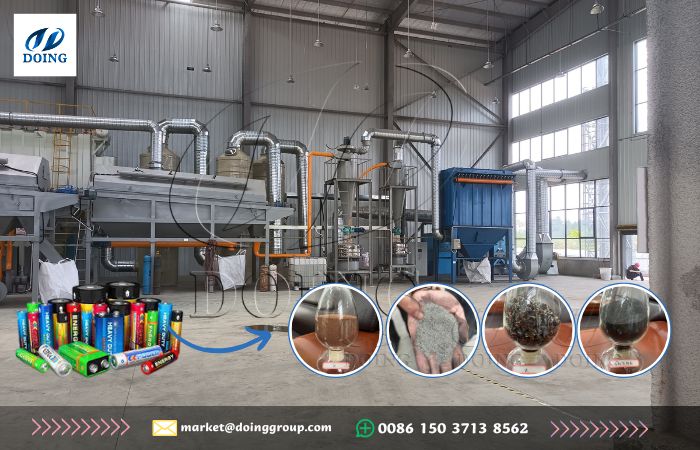 DOING ECO lithium battery recycling equipment
The important point is that recovered materials should not automatically be assumed to be non-hazardous simply because they have commercial value. Their regulatory status depends on their characteristics and the requirements of the destination country or region.
Why process design matters
For suitable feedstocks, DOING ECO's lithium battery recycling solution uses dry physical separation rather than a chemical leaching process. The process can combine crushing, magnetic separation, screening and gravity separation to separate different material fractions.
This can simplify the process by avoiding routine chemical reagents for physical material separation. However, a dry process does not eliminate the need for fire protection, dust control, safe storage, worker protection and applicable permits.
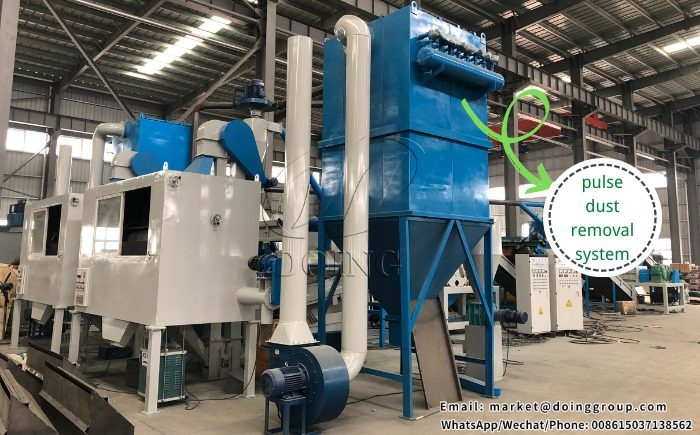 Pulse dust removal for battery recycling
DOING ECO can customize the lithium battery recycling equipment according to the battery type, feedstock condition, processing capacity and required output materials. PLC control and dust-removal systems can also be incorporated into the equipment configuration to improve process control and working-environment management.
4. What Should Be Checked Before Buying Lithium Battery Recycling Equipment?
A common mistake is to select lithium battery recycling equipment based only on processing capacity or recovery rate.
Before purchasing a lithium battery recycling machine, investors should confirm the following:
Feedstock
Define exactly what the plant will process, such as:
Consumer lithium-ion batteries
Power batteries
Cylindrical batteries
Prismatic batteries
Pouch cells
Battery packs or modules
Mixed battery waste
Different feedstocks can require different pretreatment and separation configurations.
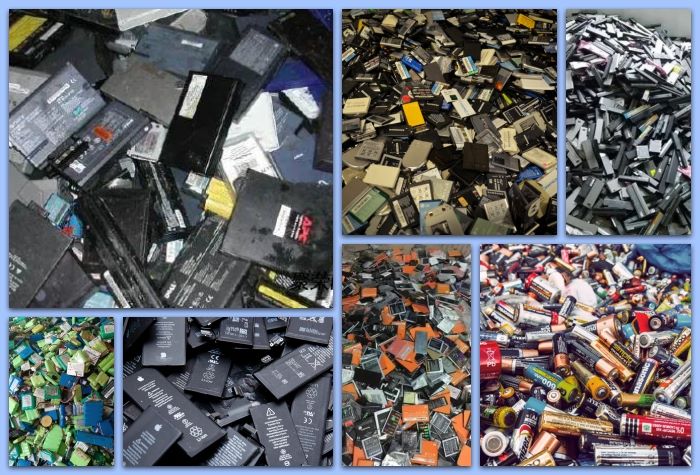 Different waste lithium battery types
Local requirements
Before finalizing the plant layout, identify the requirements for:
Waste management
Environmental permits
Fire safety
Workplace safety
Hazardous-material transportation
Air emissions
Industrial facility approval
Requirements can differ significantly between countries and even between local jurisdictions.
Equipment configuration
The equipment supplier should understand the feedstock, capacity, target outputs and plant conditions before recommending a complete line.
For example, DOING ECO can configure lithium battery recycling equipment with crushing, shredding, magnetic separation, screening, gravity separation, dust removal and PLC control according to project requirements.
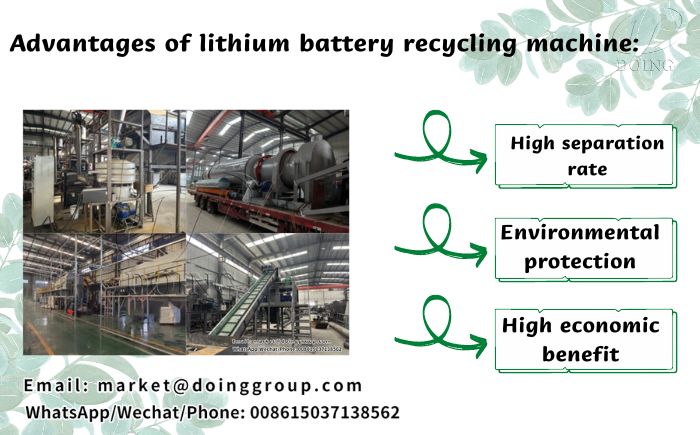 DOING ECO lithium battery recycling solution
Material testing
Testing representative battery samples before finalizing the equipment configuration can help determine a suitable process and separation system, particularly when the feedstock is mixed.
5. How Can DOING ECO Support a Compliance-Oriented Recycling Project?
Lithium battery recycling plant compliance is ultimately a project-level issue, not simply a machine specification. For a lithium battery recycling plant, the equipment needs to work together with battery storage, fire protection, dust control, operating procedures and local environmental requirements.
DOING ECO provides dry-process lithium battery recycling equipment and customized recycling solutions. Depending on the project, the system can recover copper, aluminum, iron, plastic and black powder/black mass through mechanical crushing and separation. The company can support projects from process design and equipment manufacturing to installation and commissioning, allowing the recycling process and equipment configuration to be considered together from the beginning.
FAQ
Do I need a permit to operate a lithium battery recycling plant?
It depends on the country, state or local jurisdiction, the type of batteries being processed and how the materials are classified and handled. Investors should confirm requirements with the relevant local authorities before construction.
Are lithium batteries considered hazardous waste?
Some discarded lithium-ion batteries may exhibit hazardous characteristics. Their regulatory status depends on the battery, waste classification and applicable regulations, so it should be confirmed for the specific project.
Is dry lithium battery recycling safer from a compliance perspective?
A dry physical process avoids the routine use of chemical reagents for physical separation, which can simplify some aspects of process management. However, fire, dust, storage, worker safety and waste-management requirements still need to be addressed.
What should I ask a lithium battery recycling equipment manufacturer?
Ask about the recommended process, feedstock compatibility, processing capacity, recovered materials, dust control, automation, safety considerations, installation support and equipment customization.
Can DOING ECO customize a lithium battery recycling line?
Yes. The equipment configuration can be adjusted according to the battery type, feedstock condition, processing capacity and target recovered materials. Providing representative battery samples can help with process evaluation and equipment selection.
PREV:Nothing
- Email:
- Tel/WhatsApp:
Contact Us
If you want to get more details, you can send E-mail to market@doinggroup.com. Or you can consult our professional engineers and specialized sales team by leaving a message in below form. We will contact you ASAP.