



 WhatsApp

DOING HOLDINGS
Henan Doing Environmental Protection Technology Co., Ltd
E waste recycling machine manufacturer
- WhatsApp: +86 150 3713 8562
- Email: market@doinggroup.com

Industry News

Lithium-ion battery recycling opportunity and challenges in India
 July 24, 2026
- Industry News
- Leave a message
- Chat online
According to projections by India’s NITI Aayog, the country's annual demand for lithium-ion batteries is set to climb to 210 GWh by 2030. Underlying this growth trend is the issue of large-scale recycling of spent lithium batteries.
Opportunities in the Indian Lithium-ion Battery Recycling Market
1. Strong Policy and Regulatory Drivers
In recent years, the Indian government has introduced a series of regulations and policies. Notably, the Battery Waste Management Rules (BWMR), promulgated in 2022 and further amended in 2025, explicitly introduced an Extended Producer Responsibility (EPR) framework, requiring the recovery rate for electric vehicle battery materials to reach 90% by 2026–2027.
Furthermore, the implementation of the national Production Linked Incentive (PLI) scheme for Advanced Chemistry Cell (ACC) batteries has significantly boosted the development of battery manufacturing and the associated ecosystem in India. These policies have not only regulated the market but also created substantial market opportunities for legitimate used-battery recycling enterprises.
2. Explosive Demand in the New Energy Market
The electrification process of the Indian market is accelerating; for instance, sales of electric two-wheelers alone reached approximately 1.28 million units in 2025. As early-market electric vehicles gradually approach the end of their service life, India is poised for a wave of retired lithium-ion batteries. Extracting high-value metals such as lithium, cobalt, and nickel from spent batteries can not only alleviate India's reliance on imported raw materials but also foster a highly profitable, closed-loop industrial chain.
Challenges in the Indian Lithium-Ion Battery Recycling Market
1. Competition from the informal recycling system: Currently, a portion of spent batteries in India still finds its way into informal recycling workshops. These processing methods not only cause severe environmental pollution but also result in low recovery rates for critical metals. Establishing low-cost, highly efficient, and large-scale battery recycling plants guided by formalization policies is a challenge that enterprises must address.
2. Complex and demanding recycling processes: Spent lithium batteries have complex structures comprising electrolytes, plastics, and various metals. Achieving efficient dismantling, shredding, and sorting, and even meeting the target of material recovery rates exceeding 90%, while ensuring safety and environmental compliance places extremely high demands on lithium battery recycling technologies and the underlying hardware. Traditional, simple treatment methods can no longer meet current regulatory standards.
Meeting the Challenge: Reliable Lithium Battery Recycling Machine
Amidst the opportunities and challenges of lithium-ion battery recycling in India, selecting stable, efficient, and eco-friendly recycling equipment is the key driver for enterprises to establish a competitive advantage in the Indian market.
As a professional manufacturer of lithium battery recycling machine, Doing Company is dedicated to providing global clients with mature, comprehensive equipment solutions. Equipment advantages highly aligned with the needs of the Indian market:
Multi-feedstock Processing Solutions: Henan Doing Company possesses a deep understanding of the local lithium battery market in India. Currently, the three major and stable sources of waste lithium batteries in India are:
1. Lithium batteries used in electric motorcycles, electric scooters, and electric three-wheelers passenger vehicles (e-rickshaws)
2. Retired digital lithium batteries from smartphones, laptops, tablets, drones, and smart wearable devices
3. High-capacity lithium battery packs from new energy electric vehicles (EV Battery Packs)
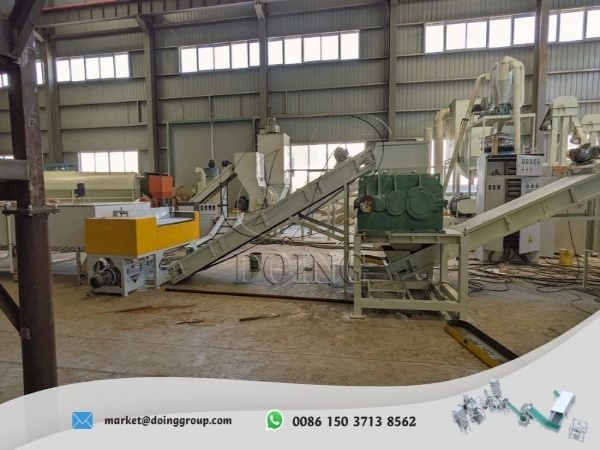
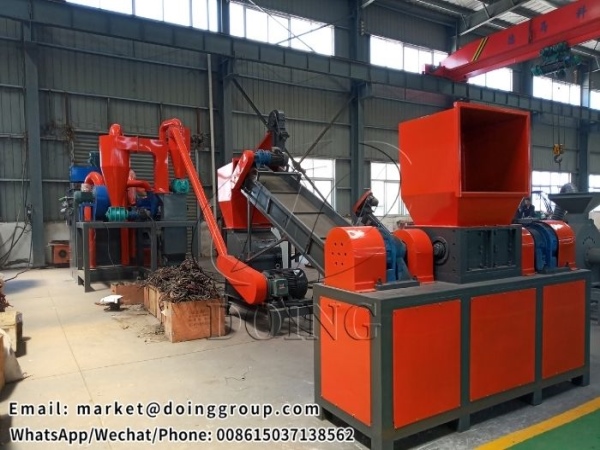
High Recovery Rates and Regulatory Compliance: Leveraging mature lithium-ion battery recycling technology: automated drying pretreatment + multi-stage crushing and sorting , DOING lithium battery recycling machine efficiently processes various types of spent lithium batteries into high-purity black mass (a mixture of metals such as lithium, cobalt, and nickel), copper, aluminum, and plastic diaphragm.
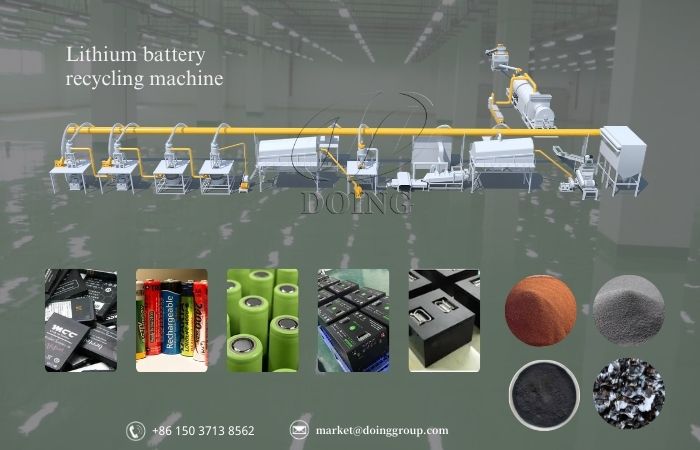 Lithium battery recycling machine for India
It achieves exceptionally high recovery rates ≥98% and metal separation purity ≥95%, enabling customers to effectively meet the stringent material recovery rate requirements mandated by India’s BWMR regulations.
Prioritizing Safety and Environmental Protection: Unlike the informal pyrometallurgical processes prevalent in the Indian market, which are highly polluting and yield low recovery rates, our equipment employs the physical separation method that eliminates the generation of excess waste and avoids safety hazards.
In addition, the recycling production line is equipped with comprehensive exhaust gas treatment and dust removal systems, ensuring the recycling process meets rigorous environmental assessment standards.
Driven by the implementation of policies and the rapid growth of the new energy vehicle sector, India's lithium-ion battery recycling market is transforming from its nascent stage to large-scale operations. Mastering efficient spent battery recycling capabilities is not only a responsibility aligned with environmental sustainability trends but also a key factor for enterprises to secure long-term commercial returns.
If you are planning to enter the Indian lithium-ion battery recycling sector and wish to gain a competitive edge in the market, please contact Doing Company. We will provide you with detailed technical specifications for lithium battery recycling equipment and customized process solutions.
Contact Us
- Email:
- Tel/WhatsApp:
News

Lithium-ion battery recycling opportunity and challenges in India
What Is The Most Environmentally Friendly Way to Dispose of Batteries?
DOING PCB Dismantling Recycling Machine Shipped to Heilongjiang, China
Chinese Customer Buys 400-500KG/H Circuit Board Recycling Line from HENAN DOING
Chinese Customer Ordered DOING PCB Dismantling Recycling Machine
Contact Us
If you want to get more details, you can send E-mail to market@doinggroup.com. Or you can consult our professional engineers and specialized sales team by leaving a message in below form. We will contact you ASAP.