

 WhatsApp

DOING HOLDINGS
Henan Doing Environmental Protection Technology Co., Ltd
E waste recycling machine manufacturer
- WhatsApp: +86 150 3713 8562
- Email: market@doinggroup.com

FAQ

What Preparations are Needed to Establish a Battery Black Mass Recycling Plant in India?
 April 8, 2026
- FAQ
- Leave a message
- Chat online
India's lithium-ion battery recycling market is growing fast, driven by rising EV adoption and government initiatives like the National Mission on Transformative Mobility and Battery Waste Management Rules 2022. By 2030, India is expected to accumulate over 50,000 tonnes of spent lithium batteries annually, much of which will be processed into black mass—a powder rich in lithium, cobalt, nickel, and manganese. Setting up an Indian battery black mass recycling plant requires careful planning, from selecting the right technology to securing permits and building a supply chain. Below are the key preparations for establishing a battery black mass recycling plant in India.
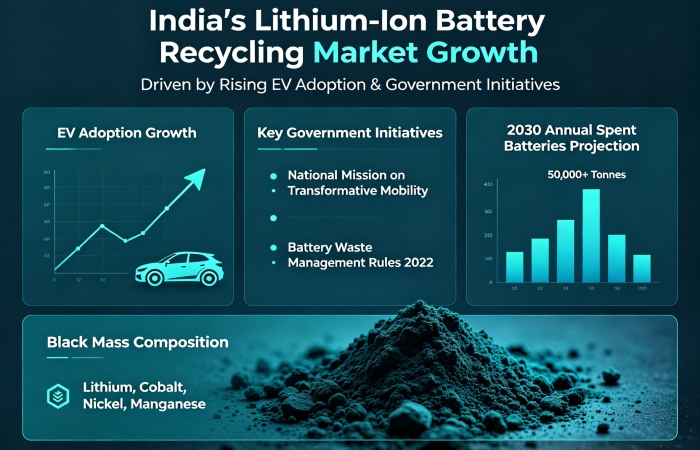 India's lithium-ion battery recycling market growth
1.Equipment Selection and Factory Construction
The first and most important step in preparations for establishing a battery black mass recycling plant in India is deciding which lithium battery separation and recycling equipment to use. Your equipment choice directly affects recovery rates and operating costs. For an Indian battery black mass recycling plant, DOING's lithium battery separation and recycling equipment offers a practical solution. DOING's lithium battery separation and recycling equipment uses a dry physical crushing and multi-stage separation process—no water or chemicals, so there is no secondary wastewater pollution. The system includes PLC automation for consistent operation and lower labor costs. Separation efficiency reaches over 98% for black mass, copper, and aluminum. More importantly, DOING integrates pulse dust collectors and other environmental protection devices to capture fine particles and gases. This design helps your plant pass CPCB's emission inspections more easily.
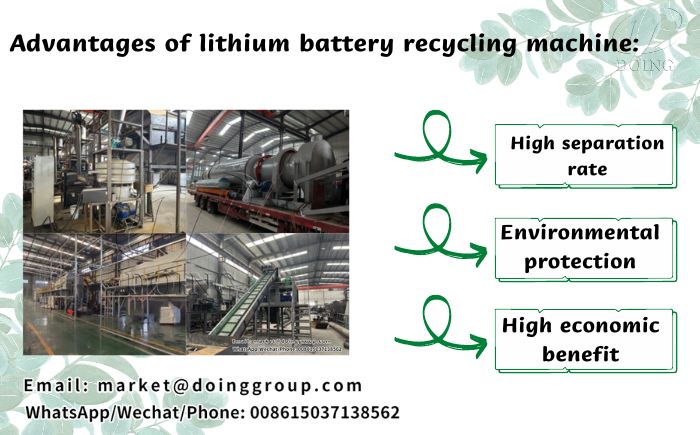 Advantages of DOING lithium battery recycling machine
Factory location and layout planning are equally important for a successful Indian battery black mass recycling plant. You should choose a location near a battery assembly center or major transportation route with a stable three-phase power supply. States like Gujarat, Maharashtra, and Tamil Nadu already have growing battery industries. Inside the factory, you need to plan material flow carefully: a receiving area for spent batteries, a storage area for hazardous waste (with proper fireproofing and ventilation), the main processing line for crushing and separation, and a dedicated area for collected black mass and metals. DOING's service team can provide guidance on factory layout based on your available space and expected capacity.
2. Secure Core Permits and Compliance Clearances
Once you have chosen your lithium battery separation and recycling equipment and planned the factory layout, you can move forward with permit applications. India's Central Pollution Control Board (CPCB) requires recyclers to register under the Battery Waste Management Rules, 2022. You will also need a consent to establish (CTE) and consent to operate (CTO) from the State Pollution Control Board (SPCB). Other clearances may include a factory license, fire safety approval, and GST registration. DOING can help obtain relevant project compliance.
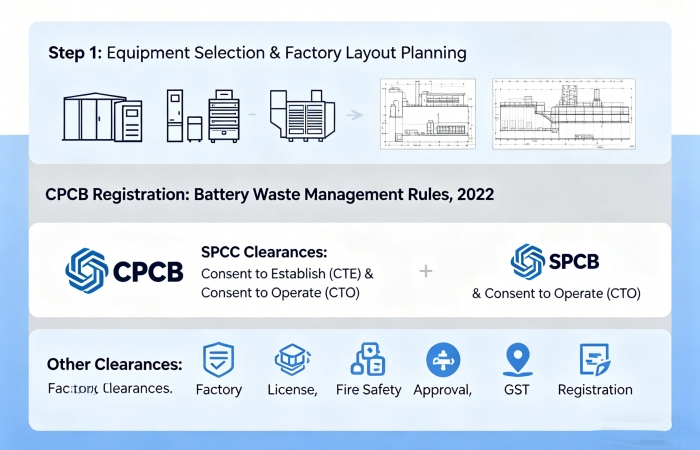 Compliance permits for lithium battery recycling plants in India
3. Build a Business Model and Secure Supply Chains
A recycling plant only runs well if you have steady feedstock and buyers for output. For an Indian battery black mass recycling plant, source your black mass from battery assemblers, EV manufacturers, e-waste recyclers, and automotive dismantlers. Many states like Gujarat, Maharashtra, and Tamil Nadu already have clustering of battery-related industries. You should also identify the purchasers of the waste materials, such as battery cathode material manufacturers and battery cell manufacturers. Furthermore, logistics need to be planned in advance: used batteries are classified as Class 9 hazardous materials and require proper packaging and transportation permits. Your business model should include buffers to cope with fluctuations in raw material prices, as well as a clear plan for used battery recycling points.
Note: Battery black material is a powdery mixture of valuable metals (nickel, cobalt, manganese, lithium) and graphite produced from the crushing of waste lithium-ion batteries, not from lead-acid batteries. When recycling raw materials, it is essential to pay attention to the type of waste battery.
If you're looking to establish an Indian battery black mass recycling plant, DOING can help you prepare. DOING's lithium battery separation and recycling equipment can handle mobile phone batteries, electric vehicle batteries (NMC, LFP), and battery electrode waste from production lines. With successful project experience in India, South Africa, Brazil, the Philippines, and Vietnam, the DOING team understands local requirements and can assist you through every stage, from commissioning to full operation. For more information on capacity selection, plant layout, or compliance support for your Indian battery black mass recycling plant, please contact DOING directly.
Contact Us
- Email:
- Tel/WhatsApp:
FAQ
Contact Us
If you want to get more details, you can send E-mail to market@doinggroup.com. Or you can consult our professional engineers and specialized sales team by leaving a message in below form. We will contact you ASAP.